
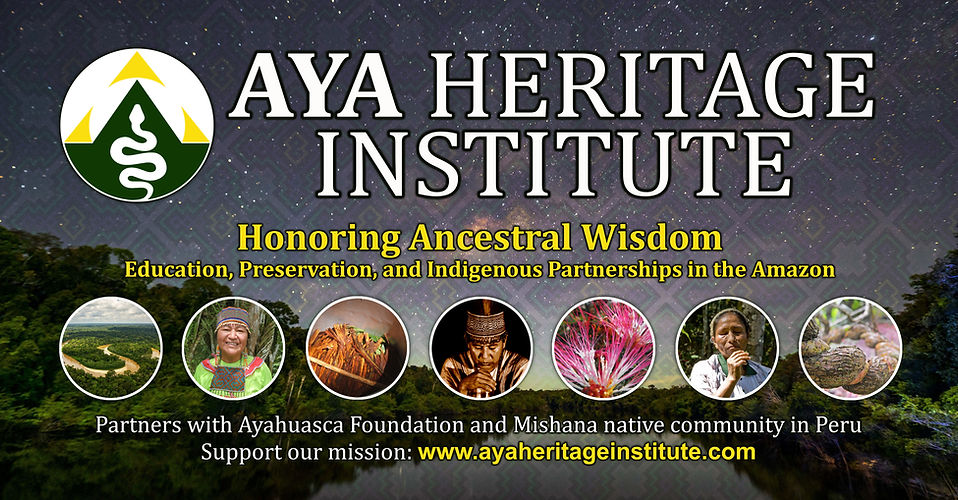

Exploring Ancestral Wisdom
At AYA HERITAGE INSTITUTE, we are dedicated to researching and preserving the rich knowledge surrounding plants and traditional ancestral wisdom.
Join us in our mission to honor ancestral traditions and foster sustainable practices.
We are currently seeking support for two primary community-based initiatives in collaboration with Indigenous partners in the Peruvian Amazon, particularly in Iquitos, Peru.
We are partners with the Indigenous Community Allpahuayo Mishana, Shipibo healers, The Ayahuasca Association (all of them from Peru)

PROJECTS
1. Indigenous Medicinal Plant Garden & Conservation Project
One of our main goals is to support the local Indigenous community of Mishana in expanding and maintaining their traditional medicinal plant gardens. These living gardens help preserve ancestral botanical knowledge while creating sustainable access to culturally important healing plants.
The project includes the cultivation, conservation, and reforestation of traditional Amazonian medicinal plants such as:
Ajo Sacha
Bobinsana
Uña de Gato (Cat’s Claw)
Mucura
Ayahuasca vine
Piñón Colorado
These gardens serve not only as a source of traditional medicine, but also as educational spaces where ancestral plant knowledge can continue to be passed down to future generations.
Support for this project helps:
-
Preserve Indigenous botanical traditions
-
Protect biodiversity in the Amazon rainforest
-
Strengthen community self-sufficiency
-
Create educational opportunities around ancestral ecological knowledge
-
Promote sustainable stewardship of medicinal plants
2. Medicinal Honey & Native Bee Regeneration Initiative
Our second initiative focuses on expanding sustainable beekeeping and native bee conservation efforts within the community.
Traditional honey has long been valued in many Indigenous cultures for its nutritional, medicinal, and ceremonial importance. Through this initiative, we aim to help establish and expand beehives that support both ecological balance and community wellness.
This project includes:
-
Building and maintaining additional beehives
-
Supporting native pollinator populations
-
Producing medicinal honey and related natural products
-
Providing community education on sustainable beekeeping
-
Encouraging regenerative environmental practices
Healthy bee populations are essential for biodiversity, plant reproduction, and the overall vitality of the rainforest ecosystem.
3. Indigenous Wisdom & Psychedelic Education Conference
This initiative seeks to create educational opportunities by bringing Indigenous healers, curanderos, and traditional knowledge keepers from the Peruvian Amazon—particularly the Shipibo-Konibo community—to Massachusetts to share their ancestral knowledge directly with the public.
Today, much of the information about Amazonian plant traditions is taught through secondary sources.
This conference aims to provide an opportunity for participants to learn directly from Indigenous practitioners who have inherited and preserved this knowledge through generations.
The conference will include:
-
Educational presentations by Indigenous healers and community leaders.
-
Discussions on traditional plant knowledge, cultural heritage, and ethical stewardship.
-
Cultural demonstrations and storytelling.
-
Educational panels on conservation, Indigenous rights, and knowledge preservation.
-
Opportunities for respectful dialogue between Indigenous communities, researchers, educators, and the public.
Support for this initiative helps:
-
Preserve Indigenous voices and traditional knowledge.
-
Create direct educational exchanges between Indigenous communities and the public.
-
Promote ethical understanding of ancestral plant traditions.
-
Strengthen cultural preservation and cross-cultural learning.
-
Support Indigenous participation in international educational events.


PLANT STUDIES
Discover the rich tapestry of ancestral plant knowledge and cultural heritage rooted in Peru, particularly within the Shipibo-Konibo lineage. Our mission is to preserve, document, and share these invaluable traditions with the world, ensuring that the wisdom of ancestors continues to thrive. Join us in celebrating and educating the public about these remarkable practices, as we honor the connection between nature culture. Together, we can keep these traditions alive for future generations to cherish.
Preserving ancestral plant knowledge and cultural heritage connects us to our roots and enriches our understanding of the environment. The Shipibo-Kon lineage offers valuable insights into sustainable living and holistic health. By documenting these traditions, we honor our ancestors and promote cultural diversity while fostering ecological balance and community identity.
Support the AYA Heritage Institute
What Does My Donation Support?
The AYA Heritage Institute Fund was launched in 2024 to directly support Indigenous cultural preservation, ancestral plant knowledge, and community-led educational initiatives.
Your contribution helps us:
🌿 Support Indigenous Communities
🌿 Educational programs and publications
Our Commitment to Transparency
100% of your donation goes directly to the communities and initiatives supported through this Fund.
AYA Heritage Institute operates exclusively for charitable and educational purposes in alignment with Section 501(c)(3) of the Internal Revenue Code. Contributions are used solely to advance educational, cultural preservation, and Indigenous partnership initiatives.

FISCAL SPONSORSHIP PROGRAM
Bring Your Charitable Vision to Life
Aya Heritage Institute's Fiscal Sponsorship Program empowers mission-aligned charitable projects to operate under our established 501(c)(3) nonprofit organization while they focus on creating meaningful impact.
We partner with initiatives that advance education, research, Indigenous knowledge, cultural preservation, environmental stewardship, community development, and other charitable purposes consistent with our mission.
Through fiscal sponsorship, projects can receive tax-deductible donations, apply for grants, and benefit from professional nonprofit administration, financial oversight, donor receipting, and compliance support.
Our goal is to help visionary leaders transform meaningful ideas into sustainable public-benefit programs while ensuring transparency, accountability, and responsible stewardship of charitable funds.


